If you live in Karachi, you already know the drill. The lights go out just as you sit down for dinner. The inverter kicks in with that familiar beep, and everyone in the house quietly recalculates how long the UPS will actually last this time. Then the fan slows down, the Wi Fi router blinks, and someone shouts “bijli chali gayi!” from the next room. Between K Electric’s load shedding schedules, rising fuel adjustment charges, and a power grid that struggles the moment the mercury crosses 40°C, Karachiites have become experts in energy survival. Generators, UPS systems, inverter batteries most homes and businesses in the city have tried some combination of these just to stay functional.
But there’s a smarter, more sustainable answer that’s quietly becoming the standard for homes and businesses across the city hybrid solar systems. Unlike a purely on grid setup or a fully off grid one, hybrid solar is built specifically for cities like Karachi places where the grid exists but can’t be fully trusted, and where sunlight is abundant almost 300+ days a year
Understanding Karachi’s Power Situation
Before we get into why hybrid solar works so well here, it’s worth laying out exactly what Karachi residents and business owners are dealing with.
1. Frequent and Unpredictable Load Shedding
Karachi’s power distribution is split into “feeders,” and depending on which feeder your area falls under, you could be facing anywhere from zero to several hours of load shedding a day. Areas with higher line losses or lower recovery rates are hit the hardest, often without much warning. For households, this means spoiled food, disrupted work from home schedules, and restless nights without a fan or AC. For businesses, it means halted production, damaged equipment, and lost revenue.
2. Extreme Heat and Peak Summer Demand
Karachi’s summers are brutal, with temperatures regularly crossing 40°C and heat index values that feel even higher. Air conditioners and fans run almost constantly from April through September, and this is exactly when the grid is under the most stress meaning load shedding tends to spike right when you need electricity the most.
3. Rising and Unpredictable Electricity Tariffs
Between base tariff increases, fuel price adjustments, and quarterly tariff adjustments, K Electric bills have become one of the most unpredictable household expenses in the city. Many families and business owners find their bills doubling or tripling year over year, with little control over the outcome.
4. Voltage Fluctuations and Grid Instability
Even when the power is technically “on,” voltage fluctuations are common, especially during peak demand hours. This can silently damage appliances, motors, and electronics over time a cost that often goes unnoticed until something breaks down.
5. Heavy Reliance on Diesel Generators
To cope, many households and virtually every commercial building in Karachi keeps a diesel or petrol generator on standby. But generators are noisy, expensive to run, require constant fuel top ups, and contribute heavily to the city’s air pollution a problem that’s only getting worse.
Put all of this together, and you get a power situation defined by one word unreliability. That’s precisely the gap hybrid solar is designed to close.
What Exactly Is a Hybrid Solar System?
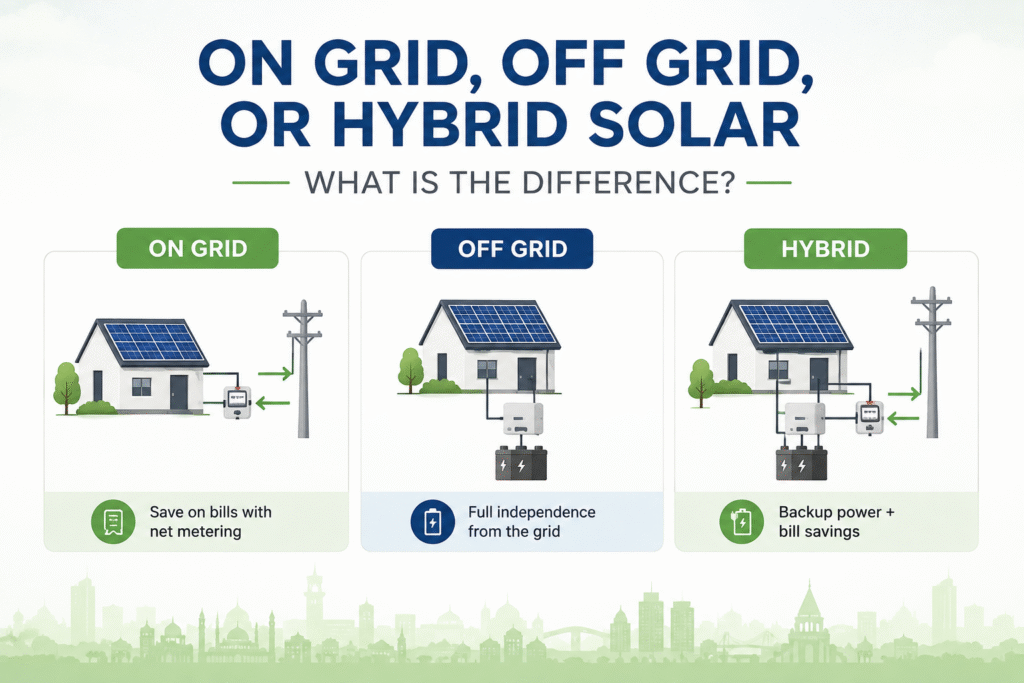
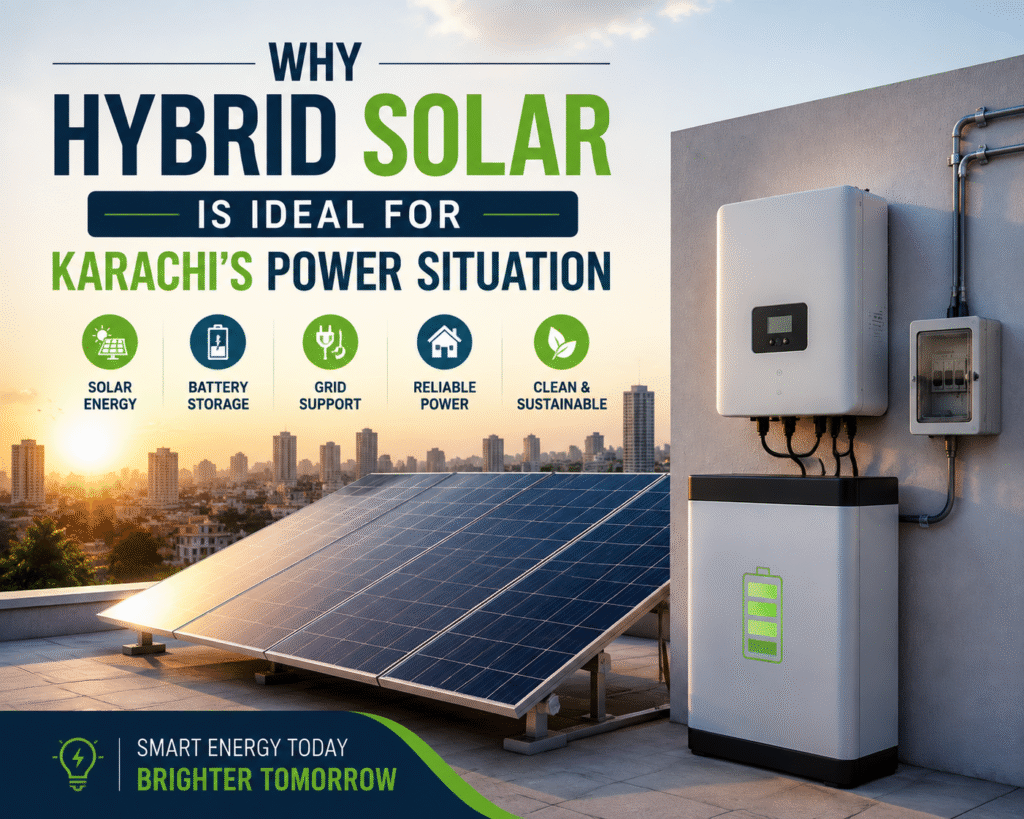
A hybrid solar system combines three components working together
- Solar panels that generate electricity from sunlight during the day
- A battery storage system that stores excess solar energy for use at night or during outages
- A grid connection that supplies power when solar and battery aren’t enough, and can even let you sell excess electricity back through net metering
The “hybrid” part comes from the fact that the system intelligently switches between these three sources solar, battery, and grid based on what’s available and what’s most cost effective at any given moment. If you want a deeper technical breakdown of how this compares to fully on grid or fully off grid setups, our Solar Hybrid Solutions guide covers it in more detail, and our Hybrid Solar Systems service page walks through how we design and install these systems for Karachi homes and businesses.
This is different from
- On grid (grid tied) solar, which generates power during the day and feeds excess back to the grid, but shuts down completely during a power outage for safety reasons meaning it doesn’t help you at all during load shedding.
- Off grid solar, which relies entirely on solar panels and batteries with no grid connection at all great for remote areas, but usually expensive and inflexible for a dense urban environment like Karachi, where grid access already exists.
Hybrid solar takes the best of both and removes the weaknesses of each. That combination is exactly why it fits Karachi so well.
Why Hybrid Solar Is the Ideal Fit for Karachi
1. It Keeps the Lights On During Load Shedding
This is the single biggest reason Karachi households are switching to hybrid systems. When K Electric cuts power to your feeder, a standard on grid solar system also shuts down it’s a legal safety requirement so that solar systems don’t feed electricity back into lines that utility workers might be repairing.
A hybrid system solves this with what’s called an “anti islanding” bypass through the battery. The moment grid power drops, your hybrid inverter automatically switches to battery and solar power, keeping your essential loads lights, fans, Wi Fi, refrigerator, even AC units depending on system size running without a single flicker. No manual switching, no waiting for a generator to start, no fuel to buy. If you’re curious about how the inverter itself manages this switching, our post on how to install a solar inverter correctly explains the mechanics behind it.
2. Battery Storage Means You’re Not Dependent on Daylight
Solar panels only generate power while the sun is up, but Karachi’s load shedding doesn’t follow a daytime only schedule evening and night outages are just as common, sometimes more so. This is where the battery component of a hybrid system becomes essential.
During the day, your panels charge the battery with any surplus energy your home doesn’t immediately use. Come evening or during a nighttime outage, that stored energy powers your home instead of pulling from an unreliable grid or firing up a generator. Our Energy Storage Systems blog goes into more detail on how battery capacity is calculated based on your household’s actual usage, and our Solar Battery Storage Solutions page outlines the battery options we install and support.
3. It Protects You From Rising and Unpredictable Tariffs
Every unit of electricity your hybrid system generates and uses is a unit you’re not buying from K Electric at ever increasing rates. Combined with net metering where any surplus solar energy you don’t use gets credited back on your bill a well sized hybrid system can dramatically shrink your monthly electricity expense, and in some cases bring it close to zero outside of peak winter months when sunlight hours are shorter.
This matters more in Karachi than almost anywhere else in Pakistan, given how frequently tariffs here get revised. A hybrid system essentially locks in a large portion of your energy costs at today’s rates, protecting your household or business budget from future hikes.
4. It’s a Genuine, Long Term Alternative to Generators
Generators feel like a solution, but they come with real hidden costs constant fuel purchases, engine maintenance, noise complaints from neighbors, and diesel fumes that aren’t great for anyone’s health especially in a city already dealing with poor air quality. A properly sized hybrid solar system replaces most or all of that generator dependency with clean, silent, self replenishing power. No fuel runs, no engine servicing, no 2 AM trips to find diesel during a fuel shortage.
5. It Protects Your Appliances From Voltage Fluctuations
Because a hybrid inverter regulates and conditions the power delivered to your home, it smooths out a lot of the voltage instability that comes with Karachi’s grid, especially during peak demand hours. That means less wear and tear on your air conditioners, refrigerators, motors, and electronics over time a benefit that often gets overlooked but adds up in avoided repair and replacement costs.
6. It’s Built for Karachi’s Climate
Karachi gets an enormous amount of sunlight throughout the year, with relatively few overcast days outside of the short monsoon season. That means solar panels here perform close to their rated capacity most months, giving hybrid systems more solar energy to work with compared to cities with less consistent sun exposure. High quality panels are also built to withstand Karachi’s intense summer heat, salty coastal air, and dust without significant performance loss, provided they’re properly maintained something we cover further down.
7. Systems Scale With You
Whether you’re a homeowner in DHA or Gulshan running a few fans, lights, and a fridge, or a business in SITE or Korangi running production equipment and cold storage, hybrid systems can be sized and later expanded to match your exact load. Start with a smaller battery and panel setup and add capacity later as your budget allows or your energy needs grow you’re not locked into a single fixed configuration from day one.
Hybrid Solar for Karachi’s Businesses, Not Just Homes
While hybrid solar gets a lot of attention for residential use, it’s arguably even more valuable for Karachi’s commercial and industrial sector. Factories in Korangi and SITE lose real money every time production halts due to an outage. Retail stores, restaurants, clinics, and offices all depend on continuous power for refrigeration, POS systems, medical equipment, and basic operations.
A hybrid setup gives businesses the same uninterrupted power benefit as homeowners, but at a scale that can offset far larger diesel generator costs generators that commercial operations often run for hours a day. If you’re evaluating this for a business property, our Commercial Solar Panel Installation service is designed around exactly these kinds of load profiles, tax incentives, and ROI calculations for Karachi based businesses.
Is Hybrid Solar Right for Everyone in Karachi?
Hybrid solar isn’t automatically the right fit for every single property, and it’s worth being upfront about that. A few things affect whether and how it makes sense for you
- Roof space and orientation: You need enough usable, largely unshaded roof area to fit a system sized for your consumption.
- Your actual electricity usage: Bigger households or businesses with heavy AC or machinery loads need a larger panel and battery setup than a small apartment.
- Budget and financing preferences: Hybrid systems cost more upfront than basic on grid setups because of the added battery component, though financing options can spread that cost out. Our Solar Financing and Leasing Options page covers ways to start saving without a large upfront payment.
- Regulatory and net metering approvals: Getting your system properly registered with K Electric for net metering involves paperwork and inspections. Our guide on how to navigate solar regulations walks through what that process actually looks like.
The best way to answer “is this right for me?” with real numbers instead of guesswork is to start with an energy audit. This tells you exactly how much power your home or business consumes, when you consume it, and how large a hybrid system you’d actually need to cover it. We’ve written about this process in detail in our posts on energy audit services in Karachi and the steps involved in a solar energy audit, and it’s also something our Energy Audits and Assessments team handles directly for property owners across the city. If you’d rather talk through your specific situation with someone before committing to anything, our Solar Energy Consulting service exists exactly for that.
Keeping a Hybrid System Performing Well in Karachi’s Conditions
One thing worth planning for from the start Karachi’s dust, humidity near the coast, and intense summer sun mean panels and batteries need some routine attention to keep performing at their rated output. Dust buildup alone can noticeably reduce panel efficiency if left unaddressed for months. Periodic checks on your inverter, wiring, and battery health also go a long way in avoiding unexpected performance drops or costly repairs down the line. We cover this in more depth through our Solar Panel Maintenance and Cleaning service and our Solar Power Audit post, both aimed at helping existing solar owners in Karachi get the most out of systems they’ve already installed.
The Bigger Picture
Karachi’s power problems aren’t going away overnight. Between an aging grid infrastructure, growing demand from a fast expanding population, and a climate that’s only getting hotter, the pressure on K Electric’s network is likely to stay high for years to come. Waiting for the grid to become fully reliable isn’t a realistic plan for most households or businesses but building your own layer of energy independence is something you can actually control today.
Hybrid solar doesn’t ask you to choose between grid convenience and energy security. It gives you both the cost savings and simplicity of staying connected to the grid, combined with the reliability of your own solar generation and battery backup whenever the grid lets you down. For a city where “lights out” is a daily possibility rather than a rare event, that combination isn’t just convenient it’s practical, and increasingly, it’s becoming the norm rather than the exception.
If you’re tired of planning your evenings around load shedding schedules, or you’re a business owner counting the real cost of running a generator every single day, it might be worth finding out what a hybrid solar system sized for your specific property would actually look like and what it would save you.