Solar energy is no longer a luxury in Pakistan it has become one of the most practical responses to rising electricity tariffs, unpredictable fuel prices, and daily load shedding. But before any homeowner or business owner buys a single panel, one question always comes up should I go on grid, off grid, or hybrid?
The three system types sound similar on the surface all of them use solar panels to capture sunlight and convert it into electricity but the way they store, use, and share that power is completely different. Choosing the wrong one can mean paying for batteries you don’t need, or worse, installing a system that still leaves you in the dark during an outage. This guide breaks down exactly how each system works, their pros and cons, their costs, and which one actually makes sense for your home or business in Karachi and across Pakistan.
Why This Decision Matters More in Pakistan Than Almost Anywhere Else
In most countries, the choice between on grid and off grid solar is mostly about budget and environmental preference. In Pakistan, it’s about something more urgent reliability. Karachi and other major cities regularly experience extended load shedding, voltage fluctuations, and unannounced outages from K Electric and other distribution companies. That single fact changes the entire calculation. A system that works beautifully in a country with a stable grid can leave a Pakistani household without power for hours every single day if it’s the wrong type. That’s why understanding these three categories isn’t just a technical detail it directly affects your electricity bill, your comfort, and your business continuity.
If you haven’t already sized your energy needs, it’s worth reading our guide on what size solar system you need for a Pakistani home before deciding which system type fits your household.
What Is an On Grid Solar System?
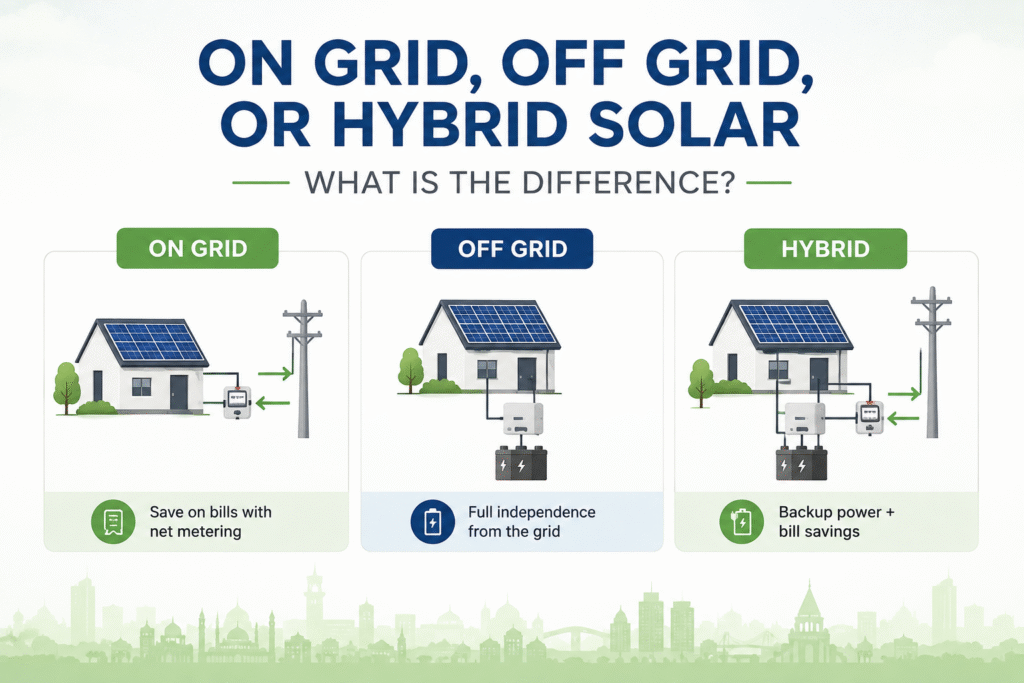
An on grid solar system, also called a grid tied system, is directly connected to the public electricity network in Karachi’s case, the K Electric grid. During the day, your solar panels generate electricity that is used to power your home in real time. If your panels produce more electricity than you’re using, the surplus is sent back into the grid, and depending on your net metering agreement, you may receive credit on your utility bill for that excess power.
How It Works
- Solar panels capture sunlight and generate DC electricity.
- A grid tied inverter converts that DC electricity into usable AC electricity.
- Your home uses this electricity first, before drawing anything from the grid.
- Any extra electricity generated is exported to the grid through a net meter.
- At night or during periods of low sunlight, your home simply draws electricity back from the grid as normal.
There is no battery involved. The grid effectively acts as your storage system you “bank” excess energy in the form of bill credits rather than storing it physically.
Advantages of On Grid Solar
- Lower upfront cost without batteries, on grid systems are the most affordable way to start saving on your electricity bill.
- Net metering savings surplus units exported to the grid reduce your monthly bill, and in some cases eliminate it almost entirely during sunny months.
- Simple maintenance fewer components mean less to service and replace over time.
- Fast return on investment because the system is cheaper to install, homeowners typically recover their investment sooner.
Disadvantages of On Grid Solar
- No power during outages This is the single biggest drawback for Pakistani users. Grid tied inverters are designed to automatically shut down during a blackout for safety reasons (so utility workers aren’t at risk of electrocution while repairing lines). That means even though your panels are producing electricity, your home still goes dark during load shedding.
- Complete dependence on the grid Your savings are tied to the utility’s net metering policy, which can change.
- Not ideal for areas with frequent, long outages Which, unfortunately, describes much of Karachi during peak summer months.
Who Should Choose On Grid Solar?
On grid solar makes the most sense for homeowners and businesses in areas with relatively stable grid supply who are primarily looking to cut their monthly electricity bill rather than gain backup power. It’s also a good entry point for anyone testing the financial benefits of solar before committing to a larger hybrid or off grid investment. To understand exactly how much you could save, our article on how solar reduces your K Electric bill breaks down real savings scenarios for Karachi households. If you’re leaning toward this route, our Residential Solar Panel Installation service is designed specifically around efficient, grid connected setups tailored to your rooftop and usage pattern.
What Is an Off Grid Solar System?
An off grid solar system operates completely independently of the public electricity grid. It relies entirely on solar panels, batteries, and a charge controller to generate, store, and supply all the electricity a home or business needs with zero connection to K Electric or any other utility.
How It Works
- Solar panels generate electricity during daylight hours.
- A charge controller regulates that electricity and directs it into a battery bank, preventing overcharging.
- The battery bank stores energy for use at night or during cloudy weather.
- An off grid inverter converts the stored DC electricity into AC power for household or business use.
- Because there is no grid connection at all, the system must be sized generously enough to cover your full energy demand, including several days of backup in case of poor sunlight.
Advantages of Off Grid Solar
- Total energy independence. No matter what happens to the grid outages, price hikes, load shedding schedules your power supply is unaffected.
- Ideal for remote or unconnected locations. Areas outside Karachi that lack reliable grid infrastructure, such as farmhouses, rural properties, or coastal developments, benefit enormously from off grid setups.
- No monthly electricity bill. Once installed, your only ongoing costs are occasional maintenance and eventual battery replacement.
- Protection from utility policy changes, since you’re not relying on net metering or grid rules at all.
Disadvantages of Off Grid Solar
- Higher upfront investment. Battery banks are the most expensive component of any solar system, and off grid setups need larger batteries to cover all your usage, not just backup power.
- System sizing is critical. Undersized batteries or panels mean running out of power during long cloudy spells or high usage days.
- Battery maintenance and replacement. Depending on the battery type, you may need to replace them every 5 to 15 years, adding to long term costs.
- No ability to sell excess power back to the grid, since there’s no connection to begin with.
Who Should Choose Off Grid Solar?
Off grid solar is the right choice for properties with no access to the grid at all, or for owners who want complete independence from the utility company regardless of cost. It’s especially popular for farmhouses, remote commercial sites, telecom towers, and coastal or upcountry properties around Sindh and Balochistan where grid infrastructure is unreliable or nonexistent.
Our dedicated Off Grid Solar Solutions service handles the full design process from calculating your daily energy consumption to selecting the right battery bank size so you’re never left short of power.
What Is a Hybrid Solar System?
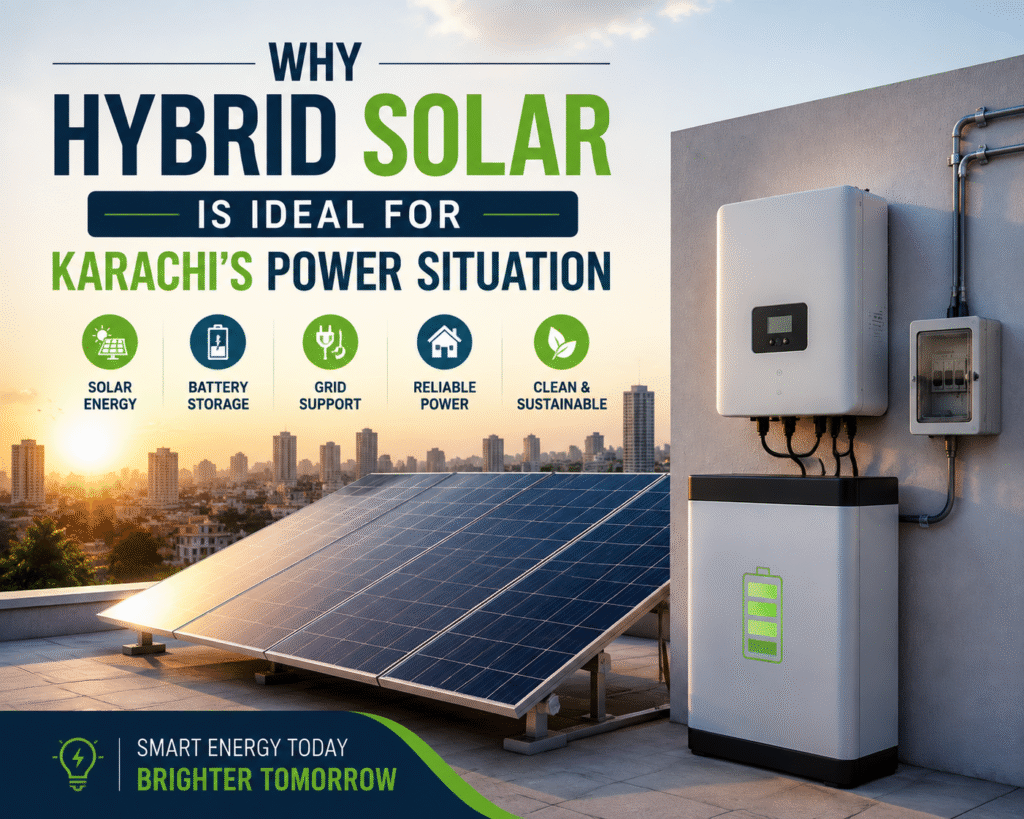
A hybrid solar system combines the best features of both on grid and off grid setups. It stays connected to the public grid, just like an on grid system, but it also includes battery storage, just like an off grid system. This combination gives you the ability to use solar power directly, store excess energy in batteries, and still fall back on the grid when needed all managed automatically by a smart hybrid inverter.
How It Works
- Solar panels generate electricity throughout the day.
- A hybrid inverter decides, in real time, how to use that electricity powering your home directly, charging the battery, or exporting surplus to the grid.
- During a power outage, the system automatically switches to battery power, keeping your essential appliances running without interruption.
- Once the battery is full and your home’s needs are met, any remaining solar power can still be exported to the grid under net metering, depending on your setup.
- At night, the system draws first from the battery, and only pulls from the grid once the battery is depleted (or according to whatever priority settings you choose).
For a deeper technical breakdown of how the inverter manages this switching process, take a look at our detailed post on how a hybrid solar system works.
Advantages of Hybrid Solar
- Backup power during outages unlike a pure on grid system, a hybrid setup keeps your lights, fans, refrigerator, and other essentials running during load shedding.
- Maximizes savings you get the benefit of net metering credits while also storing energy for personal use, rather than only exporting surplus to the grid.
- Flexible and scalable you can start with a smaller battery and expand later as your needs or budget grow, without redesigning the entire system.
- Best of both worlds grid reliability as a fallback, plus the independence of stored solar power when you need it most.
- Smart energy management many hybrid inverters let you prioritize battery charging, grid usage, or export settings based on your electricity tariff and outage patterns.
Disadvantages of Hybrid Solar
- Higher cost than on grid systems, since batteries and a more advanced inverter are required.
- More complex installation and configuration, which makes professional design and setup essential to get the balance right.
- Battery lifespan considerations still apply, though usually less critical than in a fully off grid system since the grid remains available as backup.
Who Should Choose Hybrid Solar?
Hybrid solar is, for most homeowners and businesses in Karachi, the most practical option. It directly addresses the two biggest pain points of Pakistani electricity high monthly bills and frequent outages. You get continuous power during load shedding, meaningful savings through net metering, and a system that can grow with your needs over time.
This is exactly the kind of setup our Hybrid Solar Systems service is built around combining panels, batteries, and inverters into a single system engineered for Karachi’s grid conditions and climate.
On Grid vs Off Grid vs Hybrid A Side by Side Comparison
Feature | On Grid | Off Grid | Hybrid |
Grid connection | Yes | No | Yes |
Battery storage | No | Yes (large capacity) | Yes (flexible capacity) |
Power during outages | No | Yes | Yes |
Net metering eligible | Yes | No | Usually yes |
Upfront cost | Lowest | Highest | Moderate to high |
Best for | Stable grid areas, bill reduction | Remote or unconnected properties | Areas with load shedding, most Karachi homes |
Maintenance | Low | Moderate to high (battery care) | Moderate |
Energy independence | Low | Full | Partial to high |
Key Factors to Consider Before Choosing
1. How Often Does Your Area Experience Load Shedding?
If your neighborhood regularly loses grid power for several hours a day, an on grid only system will leave you without electricity exactly when you need it most. This single factor pushes most Karachi households toward hybrid systems.
2. What’s Your Budget?
On grid systems offer the fastest payback and lowest entry cost. Hybrid systems cost more upfront but deliver both savings and backup power. Off grid systems require the largest investment because they must cover 100% of your energy needs without any grid support. Comparing these options against traditional backup solutions like generators and UPS units can also help clarify the value of each see our comparison of solar panels vs generators vs UPS in Pakistan for a full cost and reliability breakdown.
3. Do You Have Access to the Grid at All?
If your property is in a remote area without any utility connection, off grid is your only realistic option, regardless of cost.
4. What Are Your Long Term Goals?
If your priority is simply lowering your electricity bill and you’re comfortable relying on the grid at night or during outages, on grid solar is a sound, budget friendly choice. If uninterrupted power and long term independence matter more, hybrid or off grid systems are worth the extra investment.
5. How Much Electricity Do You Actually Use?
Before committing to any system type, it’s essential to understand your daily and monthly consumption. An accurate energy audit prevents both underspending on a system that can’t meet your needs and overspending on capacity you’ll never use. Our Energy Audits and Assessments service calculates your real consumption patterns so your solar system is sized correctly from day one.
6. What Type of Panels and Inverter Will You Use?
The system type you choose (on grid, off grid, or hybrid) works together with your panel technology and inverter to determine overall performance. If you’re still comparing panel options, our guide to the types of solar panels available in Pakistan explains the differences between monocrystalline, polycrystalline, and other panel types suited to Pakistan’s climate. Likewise, the inverter is the brain of the entire system our article on what a solar inverter is and why it matters explains how inverter choice affects efficiency and backup capability.
Battery Storage The Deciding Factor
Batteries are what separate on grid systems from hybrid and off grid systems, and they’re often the most misunderstood part of the decision. A battery bank determines how long you can run your home during an outage, which appliances you can safely power, and how much you’ll spend upfront and over the system’s lifetime.
Lithium ion batteries have become the preferred choice for most hybrid and off grid installations in Pakistan because of their longer lifespan, faster charging, and better performance in high temperatures compared to older lead acid batteries. However, the right battery size and chemistry depends entirely on your household’s energy consumption and backup expectations. Our Solar Battery Storage Solutions service helps homeowners and businesses select the right battery capacity and technology for their specific needs, whether that’s a modest backup for essential appliances or a full off grid battery bank.
The Inverter’s Role in Each System Type
The inverter is the component that actually determines whether a system is on grid, off grid, or hybrid it’s not just a technical detail, it’s the defining feature.
- Grid tied inverters synchronize with the utility grid and shut off automatically during outages for safety.
- Off grid inverters manage power flow entirely from batteries and panels, with no grid interaction at all.
- Hybrid inverters intelligently switch between solar, battery, and grid power sources, often within milliseconds, to keep your home powered without interruption.
Choosing the correct inverter, and having it properly installed and configured, is critical to getting the performance you expect from any of these three system types. Our Solar Inverter Installation and Replacement service ensures your inverter is matched correctly to your panels, battery bank, and household load.
Cost and Financing Considerations
Cost is often the deciding factor for most families and businesses weighing these three options. As a general rule
- On grid systems have the lowest upfront cost since they skip batteries entirely, making them the fastest to pay off through bill savings.
- Hybrid systems cost more due to the added battery and smarter inverter, but the backup power and bill savings combined often justify the investment for most Karachi households.
- Off grid systems carry the highest cost because the battery bank must be large enough to cover all your energy needs independently, with no grid to fall back on.
If the upfront cost of a hybrid or off grid system feels out of reach right now, it doesn’t have to be a barrier. Our Solar Financing and Leasing Options make it possible to spread the investment over manageable payments while you start saving on your electricity bill immediately.
Don’t Forget Long Term Maintenance
Regardless of which system you choose, regular maintenance keeps your panels performing at their best. Dust accumulation is a significant issue in Karachi due to the city’s coastal humidity and construction dust, and it can reduce panel efficiency noticeably if left unaddressed. Battery banks in hybrid and off grid systems also need periodic inspection to ensure long term reliability. Our Solar Panel Maintenance and Cleaning service keeps your system running at peak efficiency year round, protecting the investment you’ve made.
Commercial Considerations
Everything discussed so far applies just as much to businesses as it does to homeowners arguably even more so, since commercial operations often can’t afford downtime during an outage. A restaurant losing refrigeration, a factory halting production, or an office losing its servers during load shedding can be far more costly than a residential inconvenience. For business owners, hybrid systems in particular offer a strong balance between cost savings and operational continuity. Our Commercial Solar Panel Installation service is designed around the higher loads and reliability demands of commercial and industrial properties across Karachi.
Making the Right Choice for Your Property
There’s no single “best” system among on grid, off grid, and hybrid solar the right choice depends entirely on your location, budget, energy consumption, and how much you value uninterrupted power. Here’s a simplified way to think about it
- Choose on grid if you have reliable grid access, want the lowest upfront cost, and mainly want to reduce your electricity bill.
- Choose off grid if you have no grid connection at all, or you want complete independence from the utility regardless of cost.
- Choose hybrid if you experience frequent load shedding (as most of Karachi does), want meaningful bill savings, and need reliable backup power without going fully off the grid.
For the vast majority of homes and businesses in Karachi, hybrid solar strikes the most practical balance between affordability, savings, and everyday reliability. But every property is different, and the only way to know for certain is to have your energy usage, roof space, and budget properly assessed.
If you’re still unsure which system fits your situation best, our Solar Energy Consulting service walks you through the entire decision making process from understanding your energy needs to comparing system types so you can invest with confidence.
Which System Is Right for You?
Solar energy is one of the most effective ways to take control of your electricity costs and reduce your dependence on an unreliable grid but only if you choose the right type of system for your specific circumstances. On grid solar offers affordability and simplicity for those with stable grid access. Off grid solar delivers complete independence for remote properties. And hybrid solar combines the strengths of both, offering the backup power and savings that most Pakistani households genuinely need.
Whichever direction you’re leaning, getting a proper assessment before installation is the single best way to avoid costly mistakes and ensure your system performs exactly the way you expect for years to come.