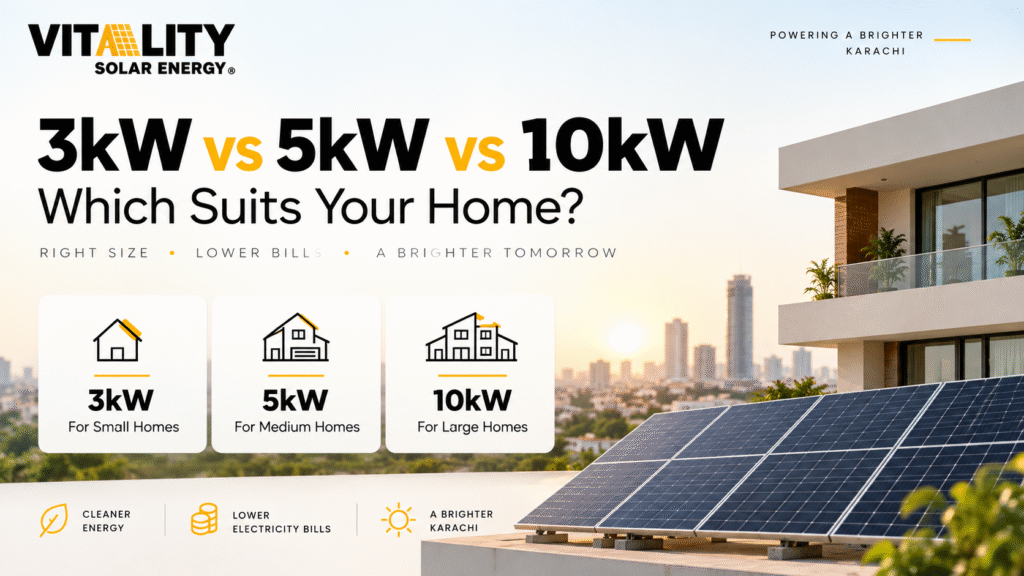
Every homeowner in Karachi eventually asks the same question after getting a few solar quotes “Do I need a 3kW, 5kW, or 10kW system?” The size you pick affects everything from your upfront cost to how many appliances you can run during a K Electric outage, and getting it wrong in either direction is an expensive mistake. Go too small, and your inverter trips every time the air conditioner kicks in, or your battery drains before load shedding ends. Go too big, and you have paid for panels and an inverter your home will never fully use, stretching your payback period for no real benefit. In a city like Karachi, where summer temperatures push past 40°C and K Electric bills climb every year, sizing the system correctly is the single most important decision in the entire solar buying process even more important than which brand of panel you choose.
This guide breaks down what a 3kW, 5kW, and 10kW solar system can actually power in a typical Karachi household, what each one costs, and how to match the right size of residential solar panel installation to your own electricity bill and lifestyle instead of guessing.
Why Solar System Size Is Such a Big Issue in Karachi
Karachi presents a unique set of challenges that most generic solar guides do not account for:
- Long, harsh summers. Air conditioners run for 8 to 12 hours a day for nearly six months of the year, and AC alone can account for 50 to 60% of a household’s total electricity consumption.
- Frequent and unpredictable load shedding. Many areas still face scheduled or unscheduled outages, which makes backup capacity not just bill savings a core part of the sizing decision.
- Rising K Electric tariffs. Even homes with moderate usage are being pushed into higher slab rates, making the size of your solar system directly tied to how much of that slab you can eliminate. If you want to understand exactly how solar cuts down your K Electric bill slab by slab, our guide on how solar reduces your monthly K Electric bill breaks this down in detail.
- Compact rooftops. Many homes, especially in older neighborhoods, have limited usable roof area, which puts a physical ceiling on how large a system you can install.
Because of these factors, a solar system size that works perfectly in Lahore or Islamabad may be completely wrong for a Karachi bungalow or a DHA/Clifton villa. Sizing has to be based on your actual bill, your roof space, and your backup needs not a one size fits all number.
The Real Issue Most Homeowners Size Their System by Budget, Not Need
The most common mistake we see is homeowners choosing a system size based purely on what feels “affordable” rather than what their home actually consumes. This leads to two frustrating outcomes:
- Undersized systems that force families to keep using K Electric during peak hours anyway, defeating the purpose of going solar.
- Oversized systems where panels sit unused for most of the day because the home’s roof, appliances, or usage pattern can never draw that much power.
The solution is to work backward from three numbers your average monthly electricity bill, the appliances you want to run during an outage, and your available rooftop space. A proper energy audit and assessment looks at all three together before recommending a system size, rather than simply matching your bill to a standard package.
Quick Comparison 3kW vs 5kW vs 10kW Solar Systems
Feature | 3kW System | 5kW System | 10kW System |
Ideal for | 1 to 2 bedroom home, small apartment | 3 to 4 bedroom home, mid size bungalow | Large bungalow, farmhouse, home based business |
Average monthly K Electric bill before solar | PKR 15,000 to 25,000 | PKR 30,000 to 55,000 | PKR 70,000+ |
Daily generation approx., Karachi sun hours | 12 to 15 units | 20 to 25 units | 40 to 50 units |
Roof space required | 250 to 350 sq. ft | 450 to 600 sq. ft | 900 to 1,200 sq. ft |
Number of panels typical 550 to 600W panels | 6 to 7 panels | 9 to 10 panels | 18 to 20 panels |
Appliances supported | Fans, lights, fridge, 1 inverter AC, TV | All of the above + 2 inverter ACs, washing machine | Multiple ACs, geysers, motor pumps, full household load |
Backup during load shedding with battery | Basic essentials for a few hours | Comfortable backup for most of the home | Near complete independence from the grid |
Approximate payback period | 3 to 4 years | 4 to 5 years | 5 to 6 years |
Note: Costs and generation figures vary based on panel brand, inverter type, and site conditions. Book a free site visit for an exact quote tailored to your home.
3kW Solar System Best for Small Homes and Light Usage
A 3kW system is the entry point for most residential solar buyers in Karachi. It typically consists of 6 to 7 solar panels and is paired with a small on grid or hybrid inverter.
Who it suits:
- Small households or apartments with 1 to 2 bedrooms
- Families whose monthly K Electric bill falls between PKR 15,000 and 25,000
- Homes that mainly need to cover lights, fans, a refrigerator, a TV, and one inverter air conditioner
What it can realistically run:
A 3kW system generates roughly 12 to 15 units of electricity per day under Karachi’s sun conditions, enough to comfortably run daily essentials plus one AC unit for a few hours in the evening. It is not designed to run multiple air conditioners simultaneously, so if your home has 2 to 3 AC units running most of the day, this size will likely fall short.
The trade off:
A 3kW system has the lowest upfront cost and the fastest, simplest installation, making it a good starting point for homeowners who want to test solar before scaling up. Many of our clients later add panels or upgrade their inverter once their needs grow, which is easier to plan for if the original installation was designed with future expansion in mind.
5kW Solar System The Most Popular Choice for Karachi Households
The 5kW system is, by far, the most commonly installed size for residential customers in Karachi, and for good reason it strikes the right balance between cost, coverage, and backup capability for the average mid sized family home.
Who it suits:
- 3 to 4 bedroom homes or bungalows 120 to 240 sq. yards
- Families with a monthly bill between PKR 30,000 and 55,000
- Households running 2 inverter ACs, a refrigerator, washing machine, water motor, and standard lighting/fan load
What it can realistically run:
Generating around 20 to 25 units per day, a 5kW system can power nearly all daily household appliances, including two air conditioners used moderately, without leaning heavily on the grid. Paired with a battery through our solar battery storage solutions, a 5kW setup can keep the essential half of the home running comfortably through several hours of load shedding.
The trade off:
The 5kW size requires more roof space roughly 450 to 600 sq. ft and a higher upfront investment than a 3kW system, but it also delivers a noticeably faster reduction in your electricity bill, especially for homes currently sitting in K Electric’s higher tariff slabs.
10kW Solar System Built for Large Homes and Heavy Loads
A 10kW system is aimed at larger properties or homes with significant daily electricity consumption think large bungalows, farmhouses, or households that also run a small home based business or guesthouse.
Who it suits:
- Large bungalows 300+ sq. yards or homes with 5+ bedrooms
- Households with monthly bills above PKR 70,000
- Homes running 3 or more air conditioners, geysers, motor pumps, and heavy kitchen appliances simultaneously
What it can realistically run:
At 40 to 50 units of daily generation, a 10kW system can cover nearly the entire electrical load of a large home, often reducing K Electric dependency to a fraction of what it was. Combined with a properly sized battery bank, many 10kW installations move close to full off grid solar independence during the day and strong backup coverage at night.
The trade off:
This is the largest investment of the three, and it also demands the most roof space often 900 to 1,200 sq. ft. For homes that don’t have this much unshaded, south facing roof area, a hybrid solar system that intelligently balances solar, battery, and grid power can sometimes achieve similar results with a slightly smaller panel footprint.
Factors That Should Actually Decide Your System Size
Instead of picking a number because a neighbor installed it, base your decision on these five factors:
- Average your monthly units consumed not just the rupee amount, since tariffs change to get a realistic baseline.
- List what you absolutely need to keep on fans, fridge, one AC, Wi Fi router versus what you can live without during load shedding.
- Trees, water tanks, and neighboring buildings can all reduce usable panel area, which directly caps your maximum system size.
- If you’re planning to add a floor, install a second AC, or expect your family to grow, it’s often more cost effective to size slightly larger now than to add capacity later.
- If you plan to sell excess units back to K Electric, an accurately sized or slightly larger system makes net metering far more worthwhile, though it also means handling the paperwork through our solar permit and regulatory assistance
If you’re unsure how to weigh these factors against each other, our detailed breakdown on choosing the right solar system size walks through the calculation step by step.
Common Sizing Mistakes Karachi Homeowners Make
- Copying a neighbor’s system size without comparing actual electricity usage, home size, or appliance load.
- Ignoring battery capacity and assuming any solar system automatically provides backup during load shedding it doesn’t, unless it’s paired with the right battery and inverter combination.
- Skipping a professional site survey, which can lead to underestimating shading or roof limitations that reduce real world output.
- Choosing the cheapest inverter for a large system, which creates a bottleneck even if you have enough panels. Comparing inverter types is worth doing separately see our guide on how a solar inverter works and why it matters before finalizing your system.
- Not comparing against alternatives. Some homeowners size their solar system without first understanding how it stacks up against a generator or UPS setup for backup purposes a comparison we cover in solar panels vs generators vs UPS.
3kW vs 5kW vs 10kW A Simple Way to Decide
If you’re still unsure, use this quick rule of thumb based on your current monthly bill:
- Bill under PKR 25,000/month: A 3kW system is usually sufficient and offers the fastest payback for smaller homes.
- Bill between PKR 30,000 to 55,000/month: A 5kW system is the sweet spot for most Karachi households, covering the majority of daily usage including multiple appliances.
- Bill above PKR 70,000/month: A 10kW system or a hybrid setup is typically needed to meaningfully offset consumption for larger homes.
These are starting points, not final answers actual sizing should always account for your roof space, appliance list, and backup goals, which is why a site visit matters more than any online calculator.
How Panel Type and Financing Affect Your Final Choice
The size of the system is only half the equation the type of panel you choose also affects how much roof space you need for the same output. Higher efficiency panels can sometimes let you fit a 5kW system into the roof space that would otherwise only accommodate a 3kW system. If you want to understand the trade offs between monocrystalline, polycrystalline, and other panel technologies available locally, take a look at our overview of solar panel types available in Pakistan.
Budget is another common constraint, especially when comparing a 5kW system against a 10kW one. Rather than downsizing purely for cost reasons, many homeowners spread the investment through our solar financing and leasing options, which can make a correctly sized system more accessible without compromising on backup or long term savings.
Frequently Asked Questions
Can a 3kW solar system run a full house in Karachi?
A 3kW system can comfortably run lights, fans, a refrigerator, and one inverter AC, but it’s generally not enough for a full house with multiple air conditioners or heavy appliance use. It’s best suited for small homes or apartments with lighter electricity needs.
Is a 5kW solar system enough for a home with two air conditioners?
Yes, in most cases. A 5kW system can typically support two inverter ACs along with standard household appliances, making it the most common choice for mid sized Karachi homes.
How much roof space is needed for a 10kW solar system?
A 10kW system generally requires about 900 to 1,200 square feet of unshaded roof space, depending on the panel wattage and layout used during installation.
Does a bigger solar system always mean bigger savings?
Not necessarily. A system larger than your actual consumption needs simply generates unused electricity unless you have net metering, in which case excess units can be sold back to the grid. Oversizing without net metering mainly increases your upfront cost without a proportional increase in savings.
Can I start with a 3kW system and upgrade to 5kW or 10kW later?
Yes, most residential setups can be expanded by adding panels and, if needed, upgrading the inverter, as long as the initial installation and roof layout are planned with future expansion in mind.
Get the Right System Size for Your Karachi Home
Choosing between a 3kW, 5kW, and 10kW solar system isn’t about picking the biggest or the cheapest option it’s about matching the system to how your household actually uses electricity, how much backup you need during load shedding, and how much roof space you realistically have. A quick session with our solar energy consulting team, backed by a proper site assessment, will tell you far more than any general estimate ever could.
If you’re ready to find your exact system size, explore our residential solar installation options or get in touch with our team for a free, no obligation site visit tailored to your home in Karachi.